2019 Solved Old Paper (BOT - 202) New


Ans.
Resemblences between Gymnosperms and Pteridophytes:-
i. Both Pteridophytes and Gymnosperms show alternation of generation with dominant sporophytic generation. ii. In both groups, the sporophyte is differentiated into roots, stem and leaves.

Ans.
Cleavage polyembryony:- It refers where the original zygote splits into many identical embryos. It is a general feature of gymnosperms. It can occur in angiosperms too but it is of rare occurrence. Monocotyledons and dicotyledons, also known as monocots and dicots, respectively, are two types of angiosperm plants.


Ans.
Systematic Position:-
Division:- Gymnospermae
Order:- Bennettitales
Family:- Williamsoniaceae
Genus:- Williamsonia

Ans.
Gymnosperms:-

> Gymnosperm:- “Gymnos” = necked and “Sperma” = seeds.
> The word Gymnosperm was first used by Theophrastus, a pupil of Aristotle in his famous book
“Enquiry into Plants”. He used this term in all those plants having unprotected (without covering) seeds.
General account:-
1. Occurrence:- Gymnosperms are found all around the planet. Most of them are present in the temperate and subarctic regions of the northern hemisphere.
2. Size:- Gymnosperms include only tall, perennial trees. The smallest gymnosperm is Zamia pygmaea, and the tallest is Sequoia sempervirens. Gnetum ula is a woody climber.
3. Plant body:- The plant body is sporophyte and divided into root, stem, and leaves.
4. Habit:- Gymnosperms are mainly evergreen and woody plants. Most of the gymnosperms are trees and shrubs. A few of them may be liana or climbers.
5. Life Span:- As gymnosperms do not produce fruits or flowers, it takes a longer time in fertilization and development. For example, a pine tree can have a lifespan of over \(100\) years.
6. Roots:- They have a fibrous root or taproot system.
7. Stems:- They are woody plants, so they have erect stems. Stems of gymnosperms can be either unbranched or highly branched.
8. Leaves:- Leaves may be simple, needle-like (Pinus, Juniper, etc.) or compound like palms. (Cycas), with a thick cuticle.
There are two main types of leaves:
a. Foliage leaves:- These are green and photosynthetic.
b. Scale leaves:- These are on the nodes and short branches, brown in colour and non-photosynthetic.
9. Xylem:- The xylem carries water and minerals to different parts of the plant and provides support. Vessels are absent in the xylem of gymnosperms. Gnetum has vessels in the secondary wood.
10. Phloem:- In most of the cases, the sieve tube, companion cells are absent in the phloem. Instead, they have sieve cells to conduct food. Albuminous cells are present in pine in place of companion cells.
11. Flower:- They do not produce flowers.
12. Microsporophyll:- In gymnosperms, microsporophyll is hard leafy triangular clusters of male cones that bear microsporangia that contain microspores.
13. Megasporophyll:- In gymnosperms, megasporophyll bears a female gamete, megasporangia containing only one megaspore. Male and female cones may be borne on the same plant (Pinus, monoecious) or different plants (Cycas, dioecious).
14. Pollination:- Pollen grains are carried from male cone to female cone by wind (Anemophily).
15. Gametophyte:-
a. Male gametophytes:- They are formed from haploid microspores. Male gametophytes or pollen grains are extremely reduced to a limited number of cells.
b. Female gametophytes:- They are highly reduced and are formed from haploid megaspore. There are integuments, so the ovules are called integumented megasporangium. All gymnosperms (except Gnetum) are unitegmic.
16. Endosperm:- They have haploid endosperms.
17. Seeds:- The seeds are naked in gymnosperms and borne in cones that are not visible till maturity.
Affinities and Relationship of Gymnosperms:- Gymnosperms occupy a place in between pteridophytes and angiosperms in the plant kingdom. Therefore, gymnosperms bear close affinities with the pteridophytes on the one hand and the angiosperms on the other. In many other characters they differ from both.
Resemblances or Similarities with Pteridophytes:-
i. Sporophytic, independent plant body is present in both the groups. It is differentiated into root, stem
and leaves.
ii. Sporophyte possess a well-developed vascular tissue.
iii. Xylem lacks vessels and phloem companion cells.
iv. Young leaves show circinate vernation.
v. Presence of megaphyllous leaves.
vi. Gymnosperm and few pteridophytes e.g. Selaginella are heterosporous i.e. form micro- and
megaspores in micro- and megosperangia, borne on the micro and megasporophylls respectively.
vii. In Cycas, sporangia are grouped in sori like pteridophytes.
viii. The female sex organ is archegonium in both the groups.
ix. The male gametes of Cycas and Ginkgo are motile like the pteridophytes.
x. Permanent retention of megaspore within the megasporangium.
xi. Gametophytes are endosporic and highly reduced.
xii. Female prothallus develops before fertilization and there is free nuclear division.
xiii. Germination of spores is precocious in gymnosperms and hetrosporous pteridophytes.
xiv. Development of distinct embryo after fertilization.
xv. Like the pteridophytes, gymnosperms show marked alternation of generation between
gametophytic and sporophytic phase. Sporophytic generation or sporphytic phase is dominant,
independent and large at maturity while the gemetophtic generation exhibits progressive reduction and
dependence.
Difference between Gymnosperms and Pteridophytes:-

Similarities with Angiosperms:-
i. Main plant body is sporophytic and is differentiated into root, stem and leaves.
ii. Plants are trees or shrubs and may be erect or climbing.
iii. Root system is well developed and the roots may be diarch, triarch, tetrach or polyarch.
iv. The xylem is exarch in the roots.
v. Stem is eusteltic. Vascular bundles are conjoint, collateral, open and endarch.
vi. Secondary growth takes place.
vii. Wood may be monoxylic or polyxylic.
viii. Vessels and companion cells also occur in some gymnosperms (Gnetales) like angiosperms.
ix. Heterosporous and have reduced gametophytes.
x. Nucellus is surrounded by integument to form a structure called ovule.
xi. Like gymnosperms many angiosperms are wind pollinated.
xii. Megaspore permanently remains inside the megasporangium and develops into female
gametophyte.
xiii. Pollen grains grow into pollen tube.
xiv. Male gametes are non-motile in majority of gymnosperms and angiosperms.
xv. Fertilization is siphonogamous.
xvi. Suspensor is formed during development of embryo.
xvii. Formation of endosperm.
zviii. Formation of seeds from ovules.
xix. As in gymnosperms, polyembryony is found in several angiosperms.
xx. Embryogeny is endoscopic.
xxi. Life cycle is similar in both groups.
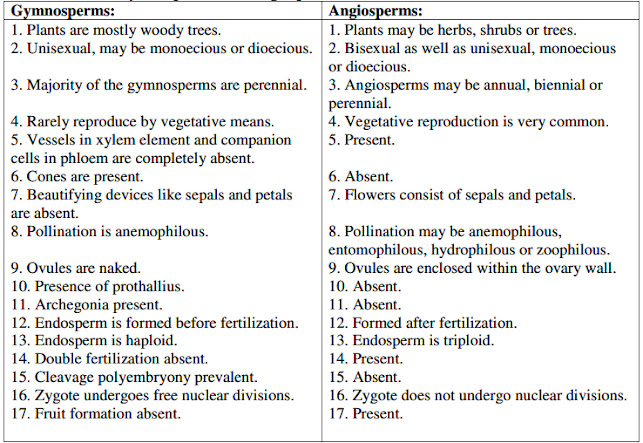
Difference between Gymnosperms and Angiosperms:-


Ans.
Systematic Position:-
Kingdom:- Plantae
Division:- Gymnospermae
Order:- Bennettitales
Family:- Cycadeoidaceae
Genus:- Cycadeoidea
Bennettitalean Flowers:-
> The reproductive organs were organised in the form of hermaphrodite (e.g. Cycadeoidea) or unisexual (e.g. Wielandiella) “flowers”, which in turn were protected by many bracts.
> The ‘flowers’ developed in the axil of leaves.
> Male reproductive organs were borne in a whorl. They were free or fused, entire or pinnately compound.
> Microsporangia were present abaxially in the form of synangia.
> Microsporophyll’s sometimes surrounded megasporophylls forming hermaphrodite “flowers”.
> Ovules were numerous and stalked and borne on a conical, cylindrical or dome-shaped receptacle.
> Many inter-seminal bracts were present on the ovule containing receptacle.
> The scales or bracts were united at end to form shield through which micropyle protrudes.

Ans.
Geological time scale:-
> Earth’s history is approximately 350 million years old.
> Geologists have used two major units for subdividing the geological history of the earth these are- time and strata.
> On the basis of time the geological history of earth has been divided into five Eras namely Archaeozoic, Proterozoic, Palaeozoic, Mesozoic and Coenozoic.
> Eras have been divided into periods and periods into epochs.
> Similarly on the basis of strata, the geological history of the Earth is divided into system,series, stage and zone.
> The various eras and their age along with plant groups evolved during that period have been described in the given figure.
.png)

Ans.
Female gametophyte:-
> The functional megaspore is the first cell of the female gametophyte.
> In Gnetum, the megaspore mother cell takes part in the development of the gametophyte. It’s containing four megaspore nuclei and forms a female gametophyte (embryo sac). The four megaspores divide continuously and form thousands of female nuclei. The embryo sac is tetrasporic, in which 256-1500 nuclei are found.
> At this time cell wall is formed from the chalazal end. A few free nuclei in this part become larger and differentiate as eggs. Archegonia are not formed in Gnetum female gametophyte.
Fertilization:- In Gnetum, the pollen tube comes in contact with the female gametophyte and the male gamete enters the embryo sac. One gamete attaches to the female nucleus and forms a zygote. While the second gamete attaches to the other nucleus and as a result double fertilization occurs. At this time, the endosperm is formed due to wall formation at the micropylar end.
Embryo development:- In Gnetum, the zygote divides and forms two cells. Both the cells enlarge and form tubes. Each tube divides and forms suspensor and embryonal cells.
Seed germination:- Seeds are endospermic. Process of germination of the seed is hypogeal in Gnetum.

Ans.
Glossopteris:-
Systematic Position:-
Kingdom:- Plantae
Division:- Gymnospermae
Order:- Glossopteridales
Family:- Glossopteridaceae
Genus:- Glossopteris
Structure:-
1. Roots of Glossopteris:-
> The detached roots of Glossopteris plant are called Vertebraria.
> The roots are flattened and grooved with wedge-like sectors that radiate from the centre of the axis.
> The wedges are made up of secondary xylem which covers the central polyarch protoxylem.
> The pycnoxylic secondary xylem strands alternate with protoxylem strands.
> In young stage, the cavities that formed between the radiating arms suggest that the plant grew in semiaquatic environment.

2. Leaves of Glossopteris:-
> Glossopteris leaves are simple, entire and sessile (rarely petiolate, e.g., G. petiolata).
> Leaves show a great variation in size and shape (linear lanceolate to spathulate ovate).
> They have a strong midrib from which numerous longitudinally running veins pass out to form a reticulate pattern or remain free.
> Leaf anatomy shows a typical dorsiventral and hypostomatic nature with irregularly dispersed haplocheilic, sunken stomata.
> Some species show a- hypodermal layer.
> Mesophyll is differentiated into palisade and spongy parenchyma. Some scale leaves (rounded or lanceolate) are found to be associated with Glossopteris leaves.
> Some other less common leaf genera namely, Gangamopteris, Palaeovittaria, Rubidgea, Euryphyllum, Rhabdotaenia are also included under Glossopteridaceae family due to their identical form, venation pattern and cuticular structure.
> Gangamopteris (Lower Permian) leaf is identical to Glossopteris except the absence of well.-defined midrib.
> Rhabdotaenia is distinguished from other leaf genera due to the presence of non-anastomosing lateral veins.

Ans.
Living and Fossil Gymnosperm in India:-
1. Cycadales:-
> Indian Cycadales are represented by only 5 species of Cycas and occur mainly in South India. These are Cycas beddomei (Madras and dry hills of Cudapah in Andhra Pradesh), C. circinalis (Andaman and Nicobar Islands and some dry deciduous forests of South India), C. rumphii (Andaman and Nicobar Islands), C griffithi (Manipur and Nega Hills) and C. pectinata (Assam, Bihar, Sikkim and several parts or Eastern India).
> C. revoluta, a Japanese species, is cultivated commonly in Indian gardens. It does not occur in wild state.
2. Gnetales:-
> Indian Gnetales include species of Gnetum and Ephedra. Welwitschia, the third genus of the order, has not been reported from India. Five species of Gnetum (viz. G. ula, G. contractum, G. gnemon, G. montanum and G. latifolium) occur in various parts of the country.
> According to Bhardwaj (1957) various Indian species of Gnetum along with their places of distribution in parenthesis include G. ula (Western Ghats near Khandala, forests of Kerala, Nilgiris, Andhra Pradesh and Orissa), G. contractum (Nilgiri Hills, Conoor and hills of Kerala), G. gnemon (eastern parts of the country, particularly Assam), G. montanum (Assam, Sikkim and parts of Orissa) and G. latifolium (Andaman and Nicobar Islands).
> Ephedra, in India, is represented by only 6 species. These are Ephedra foliata, E. gerardiana, E. intermedia, E. nebrodensis, E. regeliana and E. saxatilis. These are distributed widely in dry parts of Haryana, Punjab, Rajasthan, and parts of Sikkim, Kashmir, and also at high altitudes in Himalayas.
3. Coniferales:-
> Coniferales are the dominant forest-makers of the world. Out of 54 living genera of Coniferales in the world, ten have been reported from different parts of India. These are Abies, Cedrus, Cephalotaxus, Cupressus, Juniperus, Larix, Picea, Pinus, Podocarpus and Tsuga. The distribution of the majority of these members is restricted mainly in the Himalayas, and governed chiefly by altitudes.
Brief description of their distribution:-
- Abies is represented in the country by only 4 species, of which A. delavayi and A. densa grow in eastern Himalayas, whereas A. pindrow and A. spectabilis are restricted to western Himalayas. A. pindrow grows luxuriantly at about 2500 metres above sea level, whereas A. delavayi occurs commonly at an altitude of about 2750-3350 metres above sea level. A. densa grows luxuriantly in Darjeeling and adjacent hills.
- Cedrus, in India, is represented by only one species i.e. Cedrus deodara (vern. Deodar). This beautiful tree is famous for its wood, and grows in western Himalayas between 1200-3300 metres. Cephalotaxus grows in eastern Himalayas, and is represented by only two species (C. griffithi and C. mannii).
- Cupressus tortulosa grows throughout in the outer and middle ranges of Himalayas from Chamba hills in Himachal Pradesh to Aka Hills in Assam at an altitudes from 1800 to 2800 metres C. funiberus and C. sempervirens are cultivated as ornamental plants in Indian gardens.
- Six species of Juniperus have been reported from higher altitudes of eastern as well as western Himalayan regions of India and Bhutan. J. communis occurs between 2900-4250 metres in Garhwal Himalayas, whereas J. coxii grows both in eastern as well as Western Himalayas.
- J. macropoda grows between 2500-4300 metres in Laddakh, Kanawar and Alaknanda valley, whereas J. recurva and J. squamalata grow between 3000-5000 metres in the eastern Himalayas. J. wallichiana grows at an altitude between 3000 to 4200 metres in the Himalayan ranges.
- Larix griffithiana occurs generally mixed with Abies, Pinus and Tsuga in Sikkim, Chumbi valley of Tibet, Bhutan and Mishmi Hills in Assam. Picea smithiana grows in western Himalayas and attains a height of about 60 metres. It grows from Afghanistan to Kumaon.
- Pinus is represented by 6 species in India. These are P. roxburghii, P. wallichiana, P. insular is, P. gerardiana, P.armandi and P.merkusii. They are distributed throughout in Himalayas. Pinus roxburghii (vern. Chir) grows at lower altitudes between 2000-5000 feet, whereas P. wallichiana grows in north-west Himalayas ranging from an elevation of 5000-12000 feet.
- Pinus gerardiana (vern. Chilgoza) occurs on the Himalayan flanks extending from Punjab to Afghanistan and Baluchistan ranging within the altitudes of 5000 to 12000 feet. Pinus insularis grows in Khasia and Chittagong hills.
- Two species of Podocarpus (P.neerifolia and P. wallichianus) occur in India. The former grows in Andaman Islands and eastern Himalayas, whereas latter grows in Nilgiri hills and Assam. Tsuga dumosa grows luxuriently in Darjeeling and adjacent regions, along with Abies densa, above an altitude of 2700 metres.
- Besides the above-mentioned 10 genera, which grow naturally in different parts of India, some Coniferales are cultivated as ornamentals in Indian gardens.
- There include Araucaria cooki and A. cunninghamii of Araucariaceae, Thuja occidentalis and Cupressus cashmeriana of Cupressaceae. Callitris cupressi of Cupressaceae is grown as a hedge plant in Nilgiris, whereas Cryptomeria japonica of Taxodiaceae is grown in Darjeeling and other areas.


